> For the complete documentation index, see [llms.txt](https://docs.openg2p.org/llms.txt). Markdown versions of documentation pages are available by appending `.md` to page URLs; this page is available as [Markdown](https://docs.openg2p.org/1.3/social-registry/features/individuals-and-groups/user-guides/create-a-group-and-add-individual-registrants-to-the-group.md).
# Create a Group and Add Individual Registrants to the Group
Social Registry
This document provides instructions to create a group and add individual registrants to the group in ***Social Registry*** module.
## Prerequisites
* The user must have a Registrar or an Administrator role.
* The user must have access to the Social Registry module.
## Procedure
1. Use the link ***socialregistry.explore.openg2p.org*** to access the Social Registry.
2. Click the main menu icon  and select ***Social Registry***
You can view the ***Groups*** screen by default.
3. Click the ***New*** button.
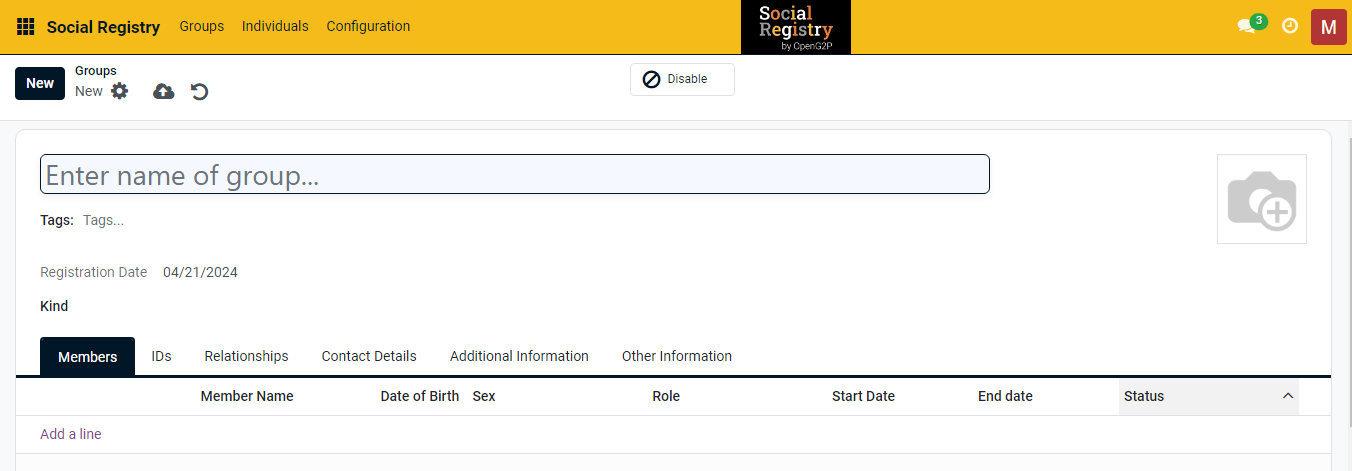
***Groups New*** screen is displayed.
The fields and their descriptions are given below:
| Field | Description |
| --------------------------------------------------------------------------------------------------------------------------------------------------------------------------------------------------------------------------------------------- | --------------------------------------------------------- |
| Enter name of the group | Enter the name of the new group. It is a mandatory field. |
| Tags | Select the tag from the drop-down |
| | Add the group member's photo |
| Registration Date | Displays the current date by default |
| Kind | Select the Kind from the drop-down |
4. Click the ***Members*** tab.
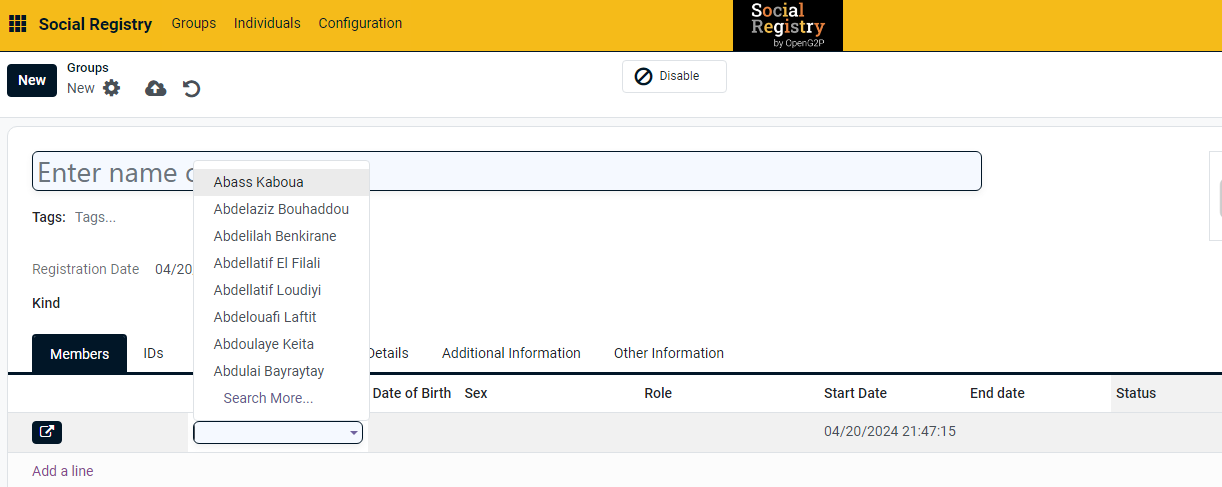
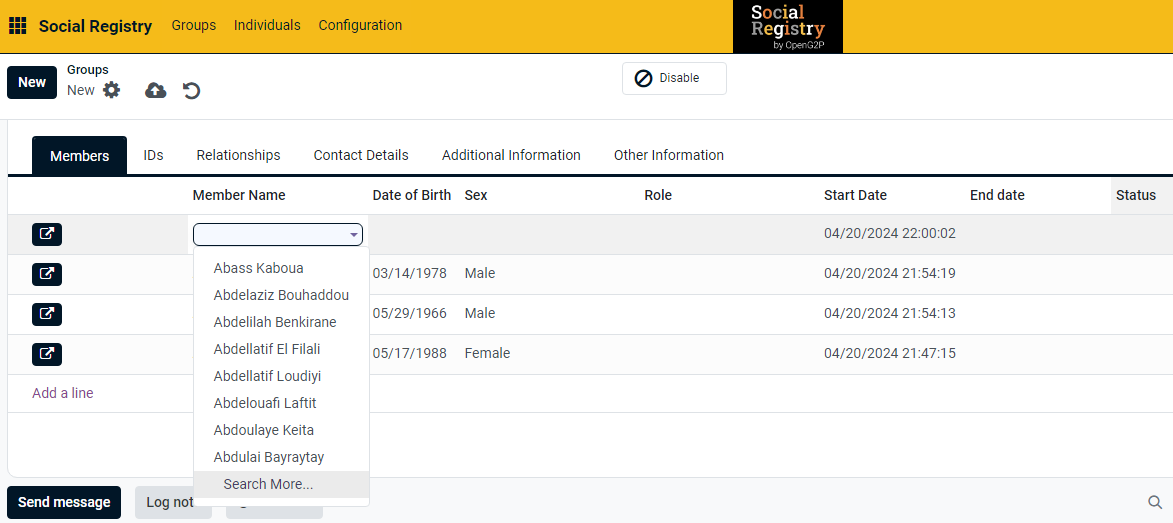
5. Click the ***Add a line.***
It enables the ***Member Name*** field.
There are two method to add individual registrants to a group.
Method 1: Select the individual registrant name from the ***Member Name*** drop-down.
Method 2: Select the ***Search More...*** option in the drop-down and add individual registrants to the group
### Method 1
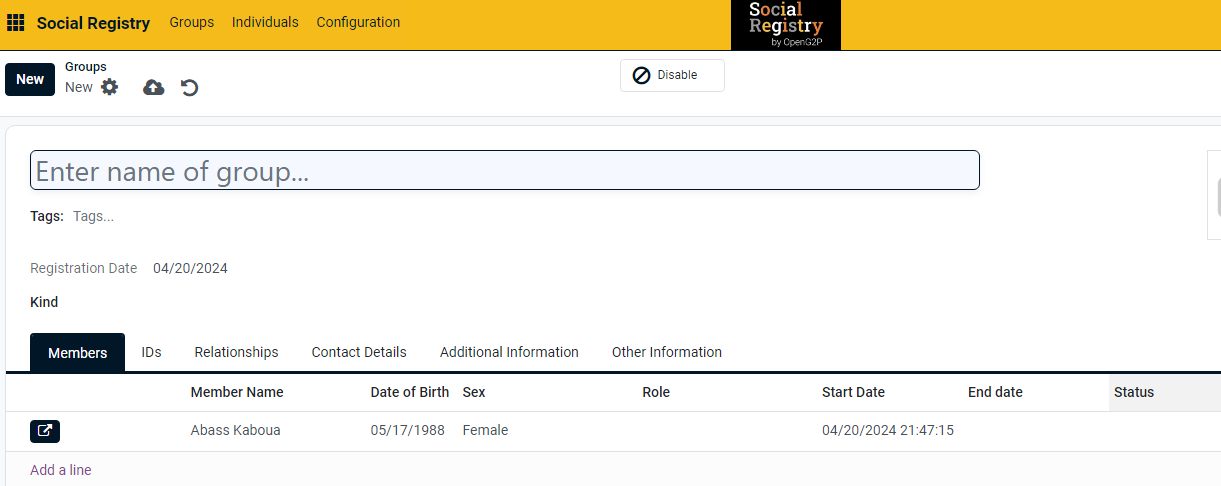
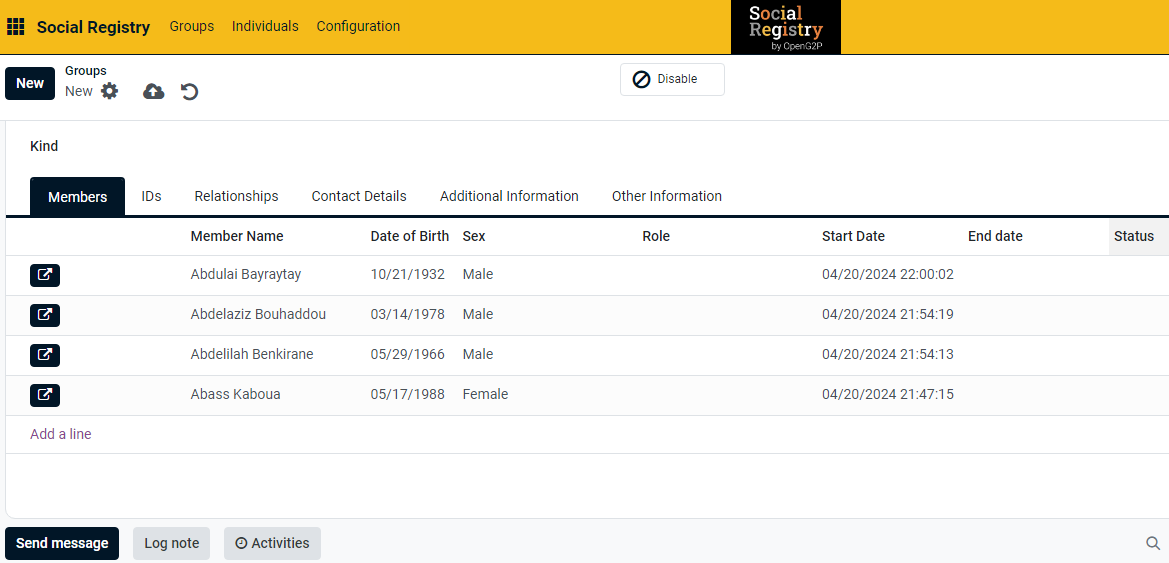
6. Select the individual registrant name from the ***Member Name*** drop-down.
It auto-populates the other fields as shown below.
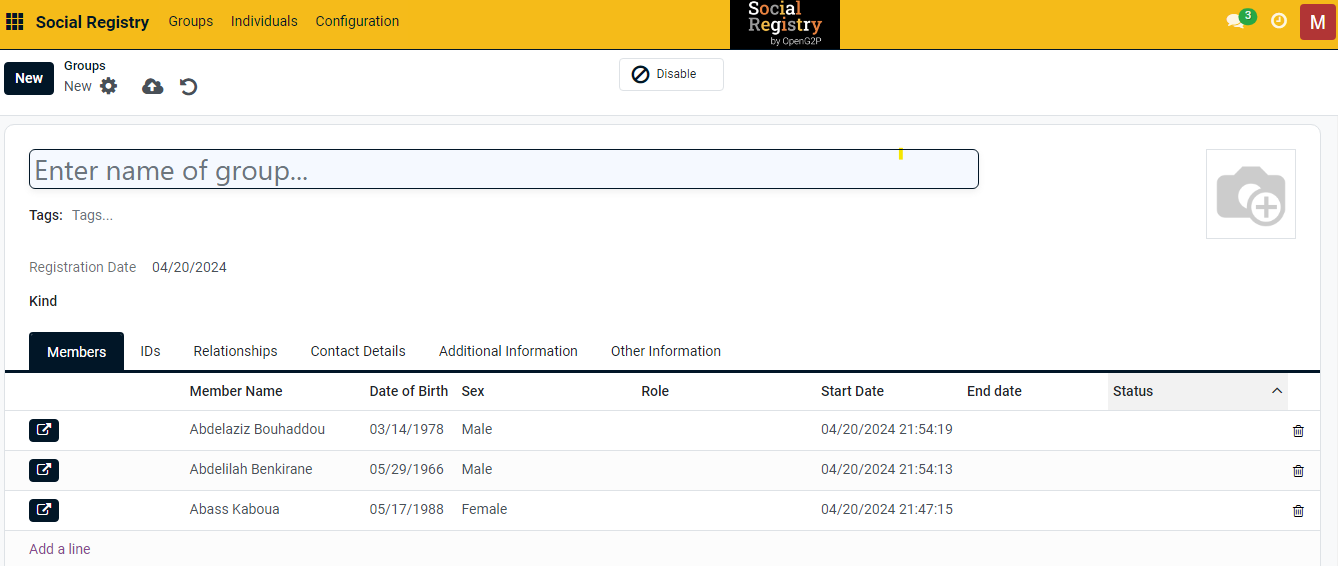
7. Repeat the step 5 and 6 to add individual registrants to a group.
8. Click the delete icon to remove the individual registrants from the group.
### Method 2
8. Click the ***Search More...*** option in the ***Member Name*** drop-down.
***Search: Member Name*** screen is displayed.
You can search and find the name of the individual registrants in the search field (or) directly click the individual registrant in the member name list. It gets added or auto-populated in the Groups screen.
| Icon | Click to |
| ------------------------------------------------------------------------------------------------------------------------------------------------------------------------------------------------------------------------------------------------------ | ------------------------------------------------------------------------------------------------------------------------------------------------------------------------------------------------------------------- |
| |
Select the appropriate value. The available values are:
Archive
Duplicate
Send SMS Text Message
Download (vCard)
Privacy Lookup
Grand portal access
|
| | Save manually the individual data to the group and exit from the screen |
| | Discard changes and exit from the screen |
The newly created group registrant gets added to the Groups list.
This completes the creation of a group and adding individual registrants to the group in the ***Social Registry*** module.
---
# Agent Instructions
This documentation is published with GitBook. GitBook is the documentation platform designed so that both humans and AI agents can read, navigate, and reason over technical content effectively. Learn more at gitbook.com.
## Querying This Documentation
If you need additional information that is not directly available in this page, you can query the documentation by asking a question.
Perform an HTTP GET request on the following URL with the `ask` and `goal` query parameters:
```
GET https://docs.openg2p.org/1.3/social-registry/features/individuals-and-groups/user-guides/create-a-group-and-add-individual-registrants-to-the-group.md?ask=&goal=
```
`ask` is the immediate question: it should be specific, self-contained, and written in natural language.
`goal` is what the user is ultimately trying to achieve, the reason they need the answer. Sharing it helps GitBook give you a better, more relevant answer. A goal is most helpful when it describes the outcome the user wants rather than restating the question. For example, with `ask=how do I create an API token`, a goal like `automate deployments from our CI pipeline` lets GitBook tailor the answer to that use case.
The response will contain a direct answer to the question and relevant excerpts and sources from the documentation.
Use this mechanism when the answer is not explicitly present in the current page, you need clarification or additional context, or you want to retrieve related documentation sections.

 | Add the group member's photo |
| Registration Date | Displays the current date by default |
| Kind | Select the Kind from the drop-down |
4. Click the ***Members*** tab.
5. Click the ***Add a line.***
It enables the ***Member Name*** field.
There are two method to add individual registrants to a group.
Method 1: Select the individual registrant name from the ***Member Name*** drop-down.
Method 2: Select the ***Search More...*** option in the drop-down and add individual registrants to the group
### Method 1
6. Select the individual registrant name from the ***Member Name*** drop-down.
| Add the group member's photo |
| Registration Date | Displays the current date by default |
| Kind | Select the Kind from the drop-down |
4. Click the ***Members*** tab.
5. Click the ***Add a line.***
It enables the ***Member Name*** field.
There are two method to add individual registrants to a group.
Method 1: Select the individual registrant name from the ***Member Name*** drop-down.
Method 2: Select the ***Search More...*** option in the drop-down and add individual registrants to the group
### Method 1
6. Select the individual registrant name from the ***Member Name*** drop-down.
.png?alt=media)
 |
|  | Save manually the individual data to the group and exit from the screen |
|
| Save manually the individual data to the group and exit from the screen |
|  | Discard changes and exit from the screen |
The newly created group registrant gets added to the Groups list.
| Discard changes and exit from the screen |
The newly created group registrant gets added to the Groups list.