> For the complete documentation index, see [llms.txt](https://docs.openg2p.org/llms.txt). Markdown versions of documentation pages are available by appending `.md` to page URLs; this page is available as [Markdown](https://docs.openg2p.org/1.3/deployment/deployment-guide/view-system-logs-on-the-opensearch-dashboard.md).
# View System Logs on the OpenSearch Dashboard
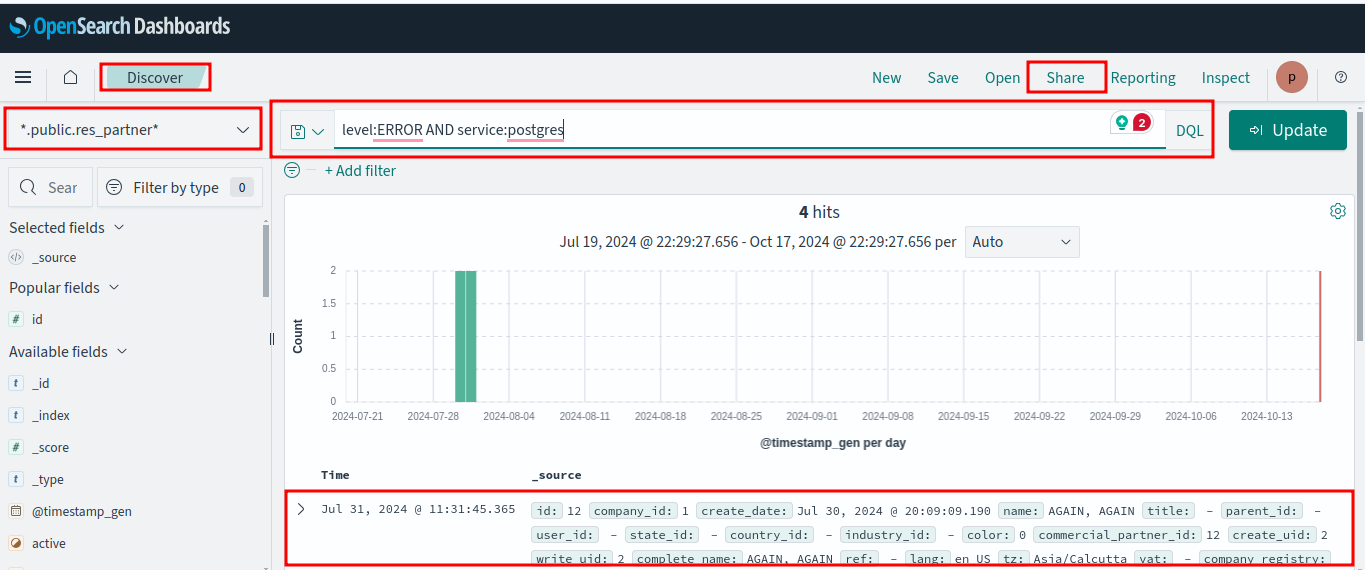
This guide will walk you through how to access, filter, and interpret system logs on the OpenSearch dashboard. Our setup leverages a reporting framework that collects logs from Docker containers and indexes them in OpenSearch for easy access and filtering.
### Viewing system logs on opensearch dashboard
1. **Access the OpenSearch Dashboard**\
Open the OpenSearch Dashboard in your browser using the provided URL. Ensure you have the necessary credentials to log in.
2. **Navigate to the Logs Section**
* Go to **Discover** from the left-hand menu.
* Select the relevant **log index pattern** (e.g., `*.public.res_partner*`) to load logs.
3. **Filter Logs by Severity (INFO, ERROR, etc.)**
* Use the search bar at the top to filter logs. For example
* `level:INFO` to see informational logs.
* `level:ERROR` to view error logs.
* You can combine filters using logical operators, like
* `level:ERROR AND service:postgres`
4. **Customize Time Range**
* Use the time picker in the top right corner to filter logs for specific periods (e.g., Last 15 minutes, Today, or Custom Range).
5. **Save Searches and Views**
* After setting up filters, click **Save** to store frequent searches for quick access.
* Use **Add Filter** or **Edit Columns** to refine how log entries are displayed.
6. **Explore and Export Logs**
* Click on individual log entries to view details.
* Use the **Share** button to generate reports or export logs if needed.
* And you can see the image below for all the operations above.\\
Opensearch-dashboard.png
* This framework provides a streamlined way to monitor and analyze logs effectively. Use filters regularly to narrow down critical information like errors or warnings.
---
# Agent Instructions
This documentation is published with GitBook. GitBook is the documentation platform designed so that both humans and AI agents can read, navigate, and reason over technical content effectively. Learn more at gitbook.com.
## Querying This Documentation
If you need additional information that is not directly available in this page, you can query the documentation by asking a question.
Perform an HTTP GET request on the following URL with the `ask` and `goal` query parameters:
```
GET https://docs.openg2p.org/1.3/deployment/deployment-guide/view-system-logs-on-the-opensearch-dashboard.md?ask=&goal=
```
`ask` is the immediate question: it should be specific, self-contained, and written in natural language.
`goal` is what the user is ultimately trying to achieve, the reason they need the answer. Sharing it helps GitBook give you a better, more relevant answer. A goal is most helpful when it describes the outcome the user wants rather than restating the question. For example, with `ask=how do I create an API token`, a goal like `automate deployments from our CI pipeline` lets GitBook tailor the answer to that use case.
The response will contain a direct answer to the question and relevant excerpts and sources from the documentation.
Use this mechanism when the answer is not explicitly present in the current page, you need clarification or additional context, or you want to retrieve related documentation sections.