

> For the complete documentation index, see [llms.txt](https://docs.openg2p.org/llms.txt). Markdown versions of documentation pages are available by appending `.md` to page URLs; this page is available as [Markdown](https://docs.openg2p.org/1.3/social-registry/features/id-integration/id-authentication/user-guides/configure-esignet-auth-provider-for-id-authentication.md).

# Configure eSignet Auth Provider for ID Authentication

This document provides instructions on how to configure eSignet Authentication Provider in PBMS to help the end-users to utilise the eSignet option to log into PBMS.

## Prerequisites

* Create an eSignet client for PBMS/Social Registry as given in eSignet Client Creation guide.
  * Create a public key and a private key JWKS pair. Use the public key JWK during eSignet creation and keep the private key JWK.
  * Allowed redirect URIs of the client must contain

    `https://socialregistry.your.org/auth_oauth/g2p_registry_id/authenticate`
* Create two ID types on the Registry such as `NATIONAL ID` and `NATIONAL ID TOKEN`. To configure ID types refer the [Configure ID Types](/1.3/pbms/functionality/beneficiary-management/beneficiary-registry-configurations/user-guides/configure-id-types.md) documentation.
* Install the [OpenID Connect Authentication](/1.3/pbms/developer-zone/odoo-modules/openid-connect-authentication.md) and [G2P Auth: OIDC - Reg ID](/1.3/pbms/developer-zone/odoo-modules/authentication-oidc-reg-id.md) module.

## Procedure

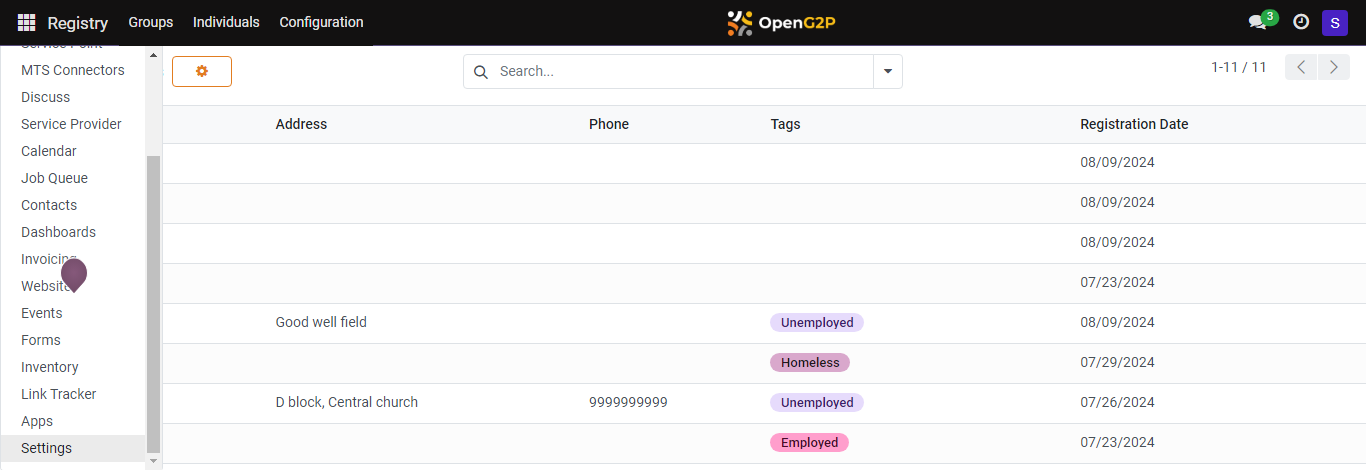
1. Click the main menu icon ![](/files/jsRVDffM09VtGFJaNGuN) and select ***Settings***.

<figure><img src="/files/HEcxwrelwY8kW9IjQwTg" alt=""><figcaption></figcaption></figure>

The ***Settings*** screen is displayed.

2. Select the tab ***Users & Companies***, and click the option ***OAUTH Providers***.

<figure><img src="/files/vhFyG5Rg3S6yV7qfK5cQ" alt=""><figcaption></figcaption></figure>

***Providers*** screen is displayed.

<figure><img src="/files/afMzgd227atKQlQmzFz1" alt=""><figcaption></figcaption></figure>

3. Click the ***New*** button.

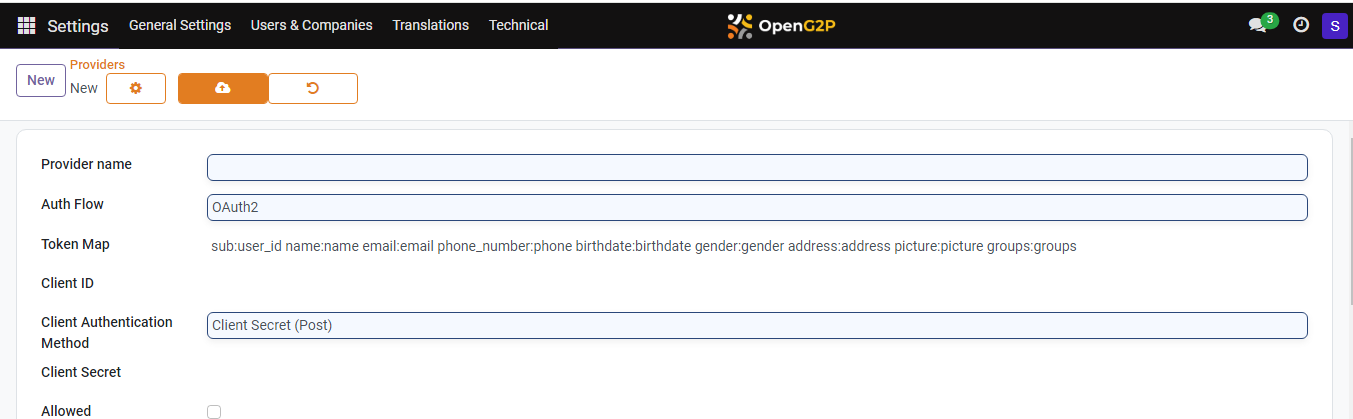
***Providers New*** screen is displayed.

<figure><img src="/files/qkey6EYTu4Nn8Lc5GxST" alt=""><figcaption></figcaption></figure>

4. Enter the values in the respective fields.

For example, the fields, their descriptions, and sample values are given below.

<table><thead><tr><th width="327">Feature</th><th width="281">Description</th><th>Value</th></tr></thead><tbody><tr><td>Provider name</td><td>Enter the provider name.</td><td>For example: eSignet for beneficiary portal</td></tr><tr><td>Auth Flow</td><td>Select the option <em><strong>OpenID Connect Authorization Code Flow</strong></em> from the drop-down.</td><td></td></tr><tr><td>Token Map</td><td>You can find a default value. In the default value replace <code>sub: user_id</code> with <code>individual_id: user_id</code>.</td><td></td></tr><tr><td>Client ID</td><td><p>The ID of the eSignet client.</p><p>To learn more refer to eSignet Client Creation.</p></td><td></td></tr><tr><td>Client Authentication Method</td><td>Select the option <em><strong>Private Key JWT</strong></em> from the drop-down.</td><td></td></tr><tr><td>Client Private Key</td><td>The <em><strong>Client Private Key</strong></em> of the eSignet client. To learn more, refer to eSignet Client Creation.</td><td></td></tr><tr><td>Allowed</td><td>Uncheck the box.</td><td></td></tr><tr><td>Allowed in Self Service Portal</td><td>Uncheck the box.</td><td></td></tr><tr><td>Allowed in Service Provider Portal</td><td>Uncheck the box.</td><td></td></tr><tr><td>Login button label</td><td>Enter the label name for the eSignet Login button.</td><td><p>For example: <code>Login with eSignet.</code></p><p>Note: This text with the button name will appear on login page.</p></td></tr><tr><td>Authorization URL, Userinfo URL, Token Endpoint, JWKS URL</td><td>These are to be configured as available in the well-known config of eSignet.</td><td></td></tr><tr><td>Verify Access Token Hash</td><td>Check the box to enable the option <em><strong>Verify Access Token</strong></em>.</td><td></td></tr><tr><td>Allow Signup</td><td>Select the option <em><strong>Denies</strong></em><strong> user signup (invitation only)</strong> from the drop-down.</td><td></td></tr><tr><td>Sync User Groups</td><td>Select the option <em><strong>Never</strong></em> from the drop-down.</td><td></td></tr><tr><td>G2P REG ID SETTINGS</td><td></td><td></td></tr><tr><td>G2P Registrant ID Type</td><td>Enter the configured ID type</td><td>For example: <code>NATIONAL ID.</code></td></tr></tbody></table>

Note:

The rest of the fields have the default values.

5. Click the icon ![](/files/pZu5xkgY6CYC21p7tlxw) to save the changes.

This completes the process of configuring the ***eSignet Authentication Provider*** in SR.

To know the process on authenticate an individual, refer [ID Authentication Process](/1.3/social-registry/features/id-integration/id-authentication/user-guides/id-authentication-process.md) documentation.


---

# Agent Instructions
This documentation is published with GitBook. GitBook is the documentation platform designed so that both humans and AI agents can read, navigate, and reason over technical content effectively. Learn more at gitbook.com.

## Querying This Documentation
If you need additional information that is not directly available in this page, you can query the documentation dynamically by asking a question.

Perform an HTTP GET request on the current page URL with the `ask` query parameter, and the optional `goal` query parameter:

```
GET https://docs.openg2p.org/1.3/social-registry/features/id-integration/id-authentication/user-guides/configure-esignet-auth-provider-for-id-authentication.md?ask=<question>&goal=<endgoal>
```

`ask` is the immediate question: it should be specific, self-contained, and written in natural language.
`goal` is optional and describes the broader end goal you are ultimately trying to accomplish on behalf of the user. GitBook uses it to tailor the answer towards what is most useful for that goal.

The response will contain a direct answer to the question and relevant excerpts and sources from the documentation.

Use this mechanism when the answer is not explicitly present in the current page, you need clarification or additional context, or you want to retrieve related documentation sections.
