> For the complete documentation index, see [llms.txt](https://docs.openg2p.org/llms.txt). Markdown versions of documentation pages are available by appending `.md` to page URLs; this page is available as [Markdown](https://docs.openg2p.org/~/changes/xKUM0sBXFkyR8F24yAMq/readme.md).
# Overview
[OpenG2P](https://openg2p.org) is an open-source platform that enables governments and humanitarian organisations to deliver critical social benefits directly to those who need them. It facilitates the building of secure, inclusive and efficient registries, program management capabilities and digital cash transfer delivery systems.
OpenG2P is a Digital Public Good (DPG) recognised by the[ DPGA](https://digitalpublicgoods.net/) and a significant building block of a country's Digital Public Infrastructure ([DPI](https://docs.cdpi.dev/dpi/readme)). OpenG2P contributes to the G2P transfers DPI layer in a digital economy, while leveraging DPGs in other categories. Its modular and interoperable technology augments existing systems in countries, without discarding what works or starting from scratch.
OpenG2P offers several modules to digitise processes of the social benefit delivery chain, including both beneficiary-facing and government-facing processes. The platform is modular, interoperable, scalable, and secure. It provides user-friendly interfaces for program managers, frontline workers, and beneficiaries to digitally interact with a country’s social protection programs. It also helps policymakers at higher levels of government get a bird’s eye view on program performance, beneficiary coverage, and public expenditure.
End-to-End process of the Social Benefits delivery chain
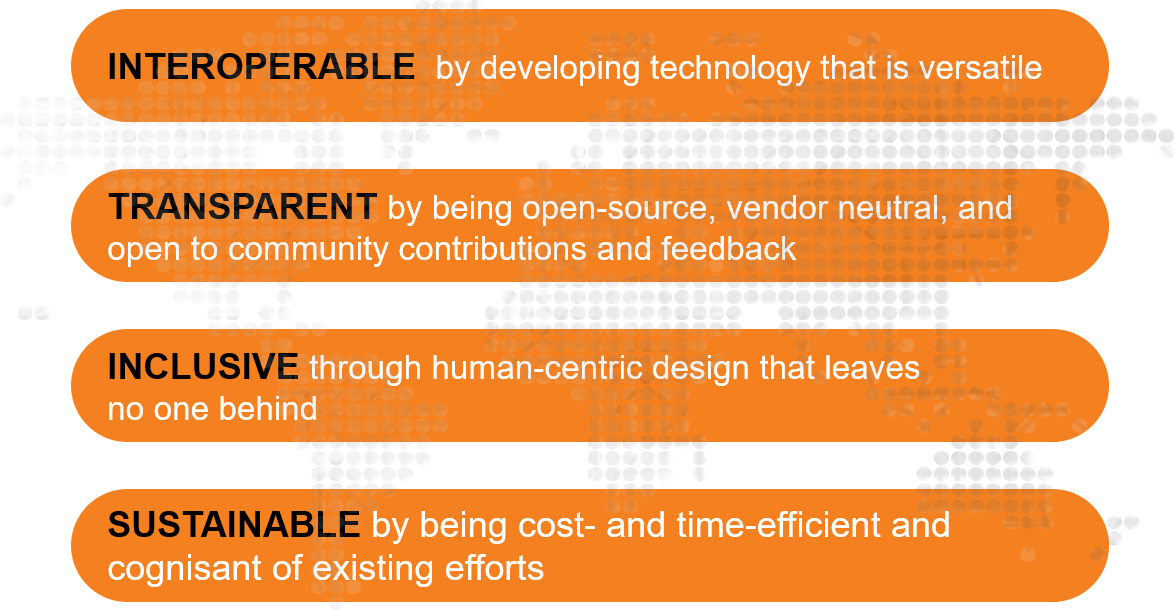
OpenG2P is built on a bedrock of good practices and principles that drive our work towards empowering populations around the world through technology.
Guiding principles
The OpenG2P code is currently available on [GitHub](https://github.com/openg2p) under [open-source licenses](/~/changes/xKUM0sBXFkyR8F24yAMq/license.md). It is currently housed in the International Institute of Information Technology, Bangalore ([IIITB](https://www.iiitb.ac.in/)), a non-profit research university.
## Functional architecture
OpenG2P has a flexible architecture that allows governments and social benefit delivery systems to choose modules per their needs. Using the OpenG2P platform, governments can digitalise the benefit delivery end-to-end and gain significantly in terms of efficiency, ease of administration, speed, cost, and convenience for the beneficiaries. The platform is built for inclusion and has supporting features. For example, beneficiaries in remote areas without network connectivity can be registered offline.
All the modules are designed to be installed and used standalone. However, the full power of OpenG2P can be harnessed if all the modules are used in conjunction with each other.
{% embed url="" %}
## Solutions/Modules offered by OpenG2P
* [PBMS](/~/changes/xKUM0sBXFkyR8F24yAMq/pbms.md) (Program and Beneficiary Management System)
* [Social Registry](/~/changes/xKUM0sBXFkyR8F24yAMq/social-registry.md)
* [SPAR](/~/changes/xKUM0sBXFkyR8F24yAMq/spar.md) (Social Payments Account Registry)
* [G2P Bridge](/~/changes/xKUM0sBXFkyR8F24yAMq/g2p-bridge.md)
* [Utilities and tools](/~/changes/xKUM0sBXFkyR8F24yAMq/utilities-and-tools.md)'
## Getting started
To run OpenG2P suite and experience all that it offers, a good start point is [**OpenG2P In a Box**](/~/changes/xKUM0sBXFkyR8F24yAMq/deployment/openg2p-in-a-box.md).
---
# Agent Instructions
This documentation is published with GitBook. GitBook is the documentation platform designed so that both humans and AI agents can read, navigate, and reason over technical content effectively. Learn more at gitbook.com.
## Querying This Documentation
If you need additional information that is not directly available in this page, you can query the documentation by asking a question.
Perform an HTTP GET request on the following URL with the `ask` and `goal` query parameters:
```
GET https://docs.openg2p.org/~/changes/xKUM0sBXFkyR8F24yAMq/readme.md?ask=&goal=
```
`ask` is the immediate question: it should be specific, self-contained, and written in natural language.
`goal` is what the user is ultimately trying to achieve, the reason they need the answer. Sharing it helps GitBook give you a better, more relevant answer. A goal is most helpful when it describes the outcome the user wants rather than restating the question. For example, with `ask=how do I create an API token`, a goal like `automate deployments from our CI pipeline` lets GitBook tailor the answer to that use case.
The response will contain a direct answer to the question and relevant excerpts and sources from the documentation.
Use this mechanism when the answer is not explicitly present in the current page, you need clarification or additional context, or you want to retrieve related documentation sections.