> For the complete documentation index, see [llms.txt](https://docs.openg2p.org/llms.txt). Markdown versions of documentation pages are available by appending `.md` to page URLs; this page is available as [Markdown](https://docs.openg2p.org/products/pbms.md).
# PBMS
Program and Beneficiary Management System
The **Program and Beneficiary Management System (PBMS)** of OpenG2P enables the management of multiple programs and beneficiaries. PBMS provides user-friendly interfaces for program managers and, frontline workers, and beneficiaries to interact with a country’s social protection programs digitally. It also helps policymakers at higher levels of government get a bird’s eye view of program performance, beneficiary coverage, and public expenditure.
The PBMS is based on [Odoo ERP/MIS](https://www.odoo.com/) and leverages Odoo's strength of easily extending modules to implement new functionality. The underlying database used is [Postgres](https://www.postgresql.org/).
Some of the key benefits for a country or an organisation using PBMS are:
* Manage **multiple** programs in one system
* Define eligibility and entitlement rules like [Proxy Means Test](/products/pbms/_archive/previous-generation/functionality/eligibility/proxy-means-test.md) (**PMT)** to automatically create eligible beneficiaries
* Maintain[ **beneficiary registry**](/products/pbms/_archive/previous-generation/functionality/beneficiary-management/beneficiary-registry.md)**.**
* Enable [**digital cash transfer**](/products/g2p-bridge.md) by seamlessly connecting to payment systems
* Offer [**self-service portal**](/products/pbms/_archive/previous-generation/functionality/self-service-portal.md) to residents
* Send [**notifications**](/products/pbms/_archive/previous-generation/functionality/notifications.md) to beneficiaries via SMS and email
* Issue digitally signed [**e-Vouchers**](/products/pbms/_archive/previous-generation/functionality/disbursement-cycles/e-voucher.md) to beneficiaries
* **Share** beneficiary data with other systems/departments in an interoperable fashion
* Pull beneficiary data from other registries (departments) to avoid the collection of the same data multiple times
The functional architecture of PBMS is shown below.
## Benefit disbursement process flow
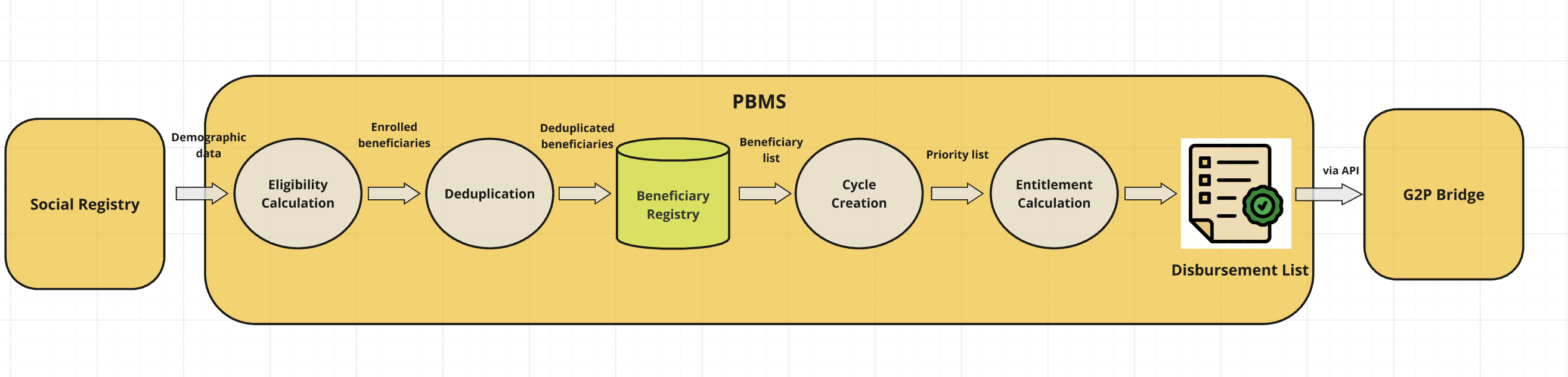
The visual below depicts the typical process flow from identifying beneficiaries to disbursement of benefits. The primary demographic data resides in the Social Registry (a separate module) while the processing of this data to generate a disbursement list is carried out in the PBMS. Notice that the PBMS holds the [Beneficiary Registry](/products/pbms/_archive/previous-generation/functionality/beneficiary-management/beneficiary-registry.md).
---
# Agent Instructions
This documentation is published with GitBook. GitBook is the documentation platform designed so that both humans and AI agents can read, navigate, and reason over technical content effectively. Learn more at gitbook.com.
## Querying This Documentation
If you need additional information that is not directly available in this page, you can query the documentation by asking a question.
Perform an HTTP GET request on the following URL with the `ask` and `goal` query parameters:
```
GET https://docs.openg2p.org/products/pbms.md?ask=&goal=
```
`ask` is the immediate question: it should be specific, self-contained, and written in natural language.
`goal` is what the user is ultimately trying to achieve, the reason they need the answer. Sharing it helps GitBook give you a better, more relevant answer. A goal is most helpful when it describes the outcome the user wants rather than restating the question. For example, with `ask=how do I create an API token`, a goal like `automate deployments from our CI pipeline` lets GitBook tailor the answer to that use case.
The response will contain a direct answer to the question and relevant excerpts and sources from the documentation.
Use this mechanism when the answer is not explicitly present in the current page, you need clarification or additional context, or you want to retrieve related documentation sections.