> For the complete documentation index, see [llms.txt](https://docs.openg2p.org/llms.txt). Markdown versions of documentation pages are available by appending `.md` to page URLs; this page is available as [Markdown](https://docs.openg2p.org/platform/platform-services/connector.md).
# Connector
The integration layer between external data sources and the OpenG2P Registry. Receives or fetches data, verifies who sent it, reshapes each record, and delivers signed batches to the Registry Partner
## Overview
Registry data rarely originates in the registry. It comes from household survey platforms, partner ministries, agency systems, and other registries that already hold information about the people a programme serves. The **Connector** is the component that brings that data in.
It accepts data from an external system, converts each record into the shape the registry expects, and delivers it to the registry **Partner API**, where it becomes a change request and enters the normal verification and approval workflow. The registry remains the authority on what is accepted. The connector's job is to get data to its door in a form it can act on, at a rate it can absorb, and to keep an accurate account of what happened to every record along the way.
Each integration is set up as a **pipeline**. A pipeline describes one source: how its data arrives, how the connector authenticates to it, how each record is reshaped, which partner the data is attributed to, and which register it belongs in. Operators create and adjust pipelines through the **Connector Admin UI**. Adding a source does not require a code change or a redeployment.
## Design at a glance
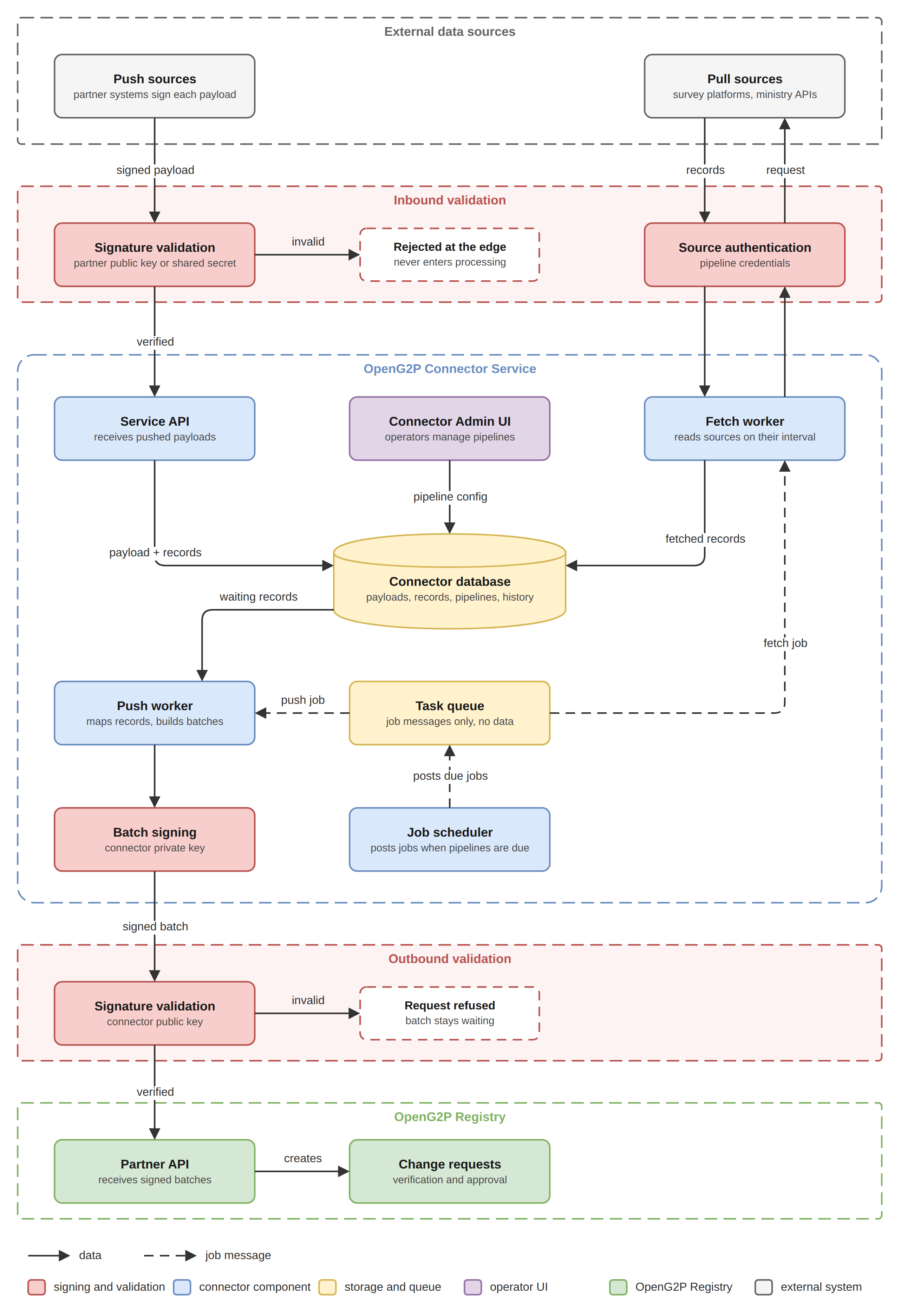
Connector Service architecture
Data reaches the connector by push or by fetch. Partner signatures are validated on the way in, and anything that fails is rejected at the edge. Everything received is written to the connector database. The push worker reads from that database, signs each batch with the connector key, and delivers it to the registry, where the connector signature is validated before the Partner API accepts it.
## Scope
The connector is responsible for:
* accepting data over the supported transports and verifying that it came from a trusted sender
* keeping an unaltered copy of everything it receives
* breaking a payload into the individual records it contains and tracking each one separately
* reshaping records into the registry's format and, where configured, validating them before delivery
* sending records to the registry in controlled batches and recording the outcome
* retrying what can be retried and holding the rest for an operator to review
The connector does not decide whether a record is correct, does not deduplicate against registry contents, and does not approve anything. Those are registry responsibilities and happen after delivery. The connector also does not act as a long-term store of registry data; the copies it keeps exist to support tracing, retry, and replay.
## In this section
| Page | Covers |
| ----------------------------------------------------------------------------------------------- | ------------------------------------------------------------------------------------------------- |
| [Functional Specifications](/platform/platform-services/connector/functional-specifications.md) | Pipelines, transports, partner trust, receiving, fetching, delivery, failure handling, operations |
| [Technical Architecture](/platform/platform-services/connector/technical-architecture.md) | Components, the database and the task queue, background workers, stored data |
| [Deployment](/platform/platform-services/connector/deployment.md) | Runtime roles, scaling, dependencies, health checks |
## Related documentation
* [OpenG2P Registry](/products/registry/registry.md)
* [Registry ingestion pipeline](/products/registry/registry/design/ingestion-pipeline.md)
* [Registry partner APIs](/products/registry/registry/design/partner-apis.md)
---
# Agent Instructions
This documentation is published with GitBook. GitBook is the documentation platform designed so that both humans and AI agents can read, navigate, and reason over technical content effectively. Learn more at gitbook.com.
## Querying This Documentation
If you need additional information that is not directly available in this page, you can query the documentation by asking a question.
Perform an HTTP GET request on the following URL with the `ask` and `goal` query parameters:
```
GET https://docs.openg2p.org/platform/platform-services/connector.md?ask=&goal=
```
`ask` is the immediate question: it should be specific, self-contained, and written in natural language.
`goal` is what the user is ultimately trying to achieve, the reason they need the answer. Sharing it helps GitBook give you a better, more relevant answer. A goal is most helpful when it describes the outcome the user wants rather than restating the question. For example, with `ask=how do I create an API token`, a goal like `automate deployments from our CI pipeline` lets GitBook tailor the answer to that use case.
The response will contain a direct answer to the question and relevant excerpts and sources from the documentation.
Use this mechanism when the answer is not explicitly present in the current page, you need clarification or additional context, or you want to retrieve related documentation sections.