> For the complete documentation index, see [llms.txt](https://docs.openg2p.org/llms.txt). Markdown versions of documentation pages are available by appending `.md` to page URLs; this page is available as [Markdown](https://docs.openg2p.org/operations/deployment/_archive/scaling/base-infrastructure/wireguard-bastion/install-wireguard-app-and-activate-tunnel.md).
# Install WireGuard Client on Android Device
## Description
The guide here provides steps to install WireGuard app on Android device and to activate the tunnel. This app allows users to create an encrypted VPN for secure communication.
## Prerequisites
The prerequisites to install WireGuard on Android device are:
1. A user must have an Android Phone.
2. Before proceeding with the installation, obtain the WireGuard conf file from a System Administrator.
## Procedure
The steps to install WireGuard in an Android device are:
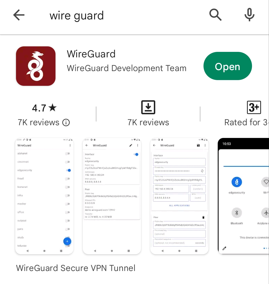
1. In the Android play store, search for "wireguard" and then tap **Install**.
2. After the successful installation, tap **Open**
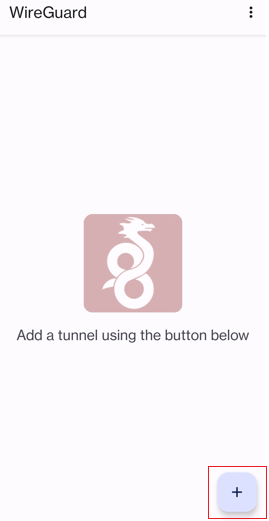
WireGuard application
2. Tap the + icon to add the tunnel.
WireGuard application - Add tunnel
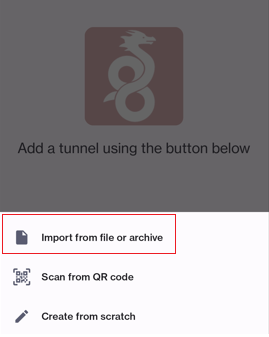
3. A list of options appear at the bottom of the app. Tap the *Import from file or archive* option.
4. Tap the WireGuard conf file provided by the system administrator.
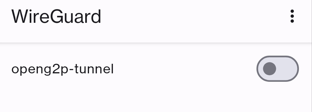
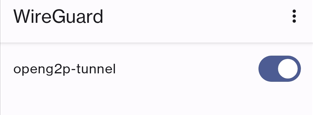
5. On successful tunnel creation, the tunnel name will appear at the top of the app.
5. Tap to activate the tunnel in WireGuard.
---
# Agent Instructions
This documentation is published with GitBook. GitBook is the documentation platform designed so that both humans and AI agents can read, navigate, and reason over technical content effectively. Learn more at gitbook.com.
## Querying This Documentation
If you need additional information that is not directly available in this page, you can query the documentation by asking a question.
Perform an HTTP GET request on the following URL with the `ask` and `goal` query parameters:
```
GET https://docs.openg2p.org/operations/deployment/_archive/scaling/base-infrastructure/wireguard-bastion/install-wireguard-app-and-activate-tunnel.md?ask=&goal=
```
`ask` is the immediate question: it should be specific, self-contained, and written in natural language.
`goal` is what the user is ultimately trying to achieve, the reason they need the answer. Sharing it helps GitBook give you a better, more relevant answer. A goal is most helpful when it describes the outcome the user wants rather than restating the question. For example, with `ask=how do I create an API token`, a goal like `automate deployments from our CI pipeline` lets GitBook tailor the answer to that use case.
The response will contain a direct answer to the question and relevant excerpts and sources from the documentation.
Use this mechanism when the answer is not explicitly present in the current page, you need clarification or additional context, or you want to retrieve related documentation sections.